DATE: April 12, 2022
TIME: 1:30pm – 3:00pm
LOCATION: Zoom
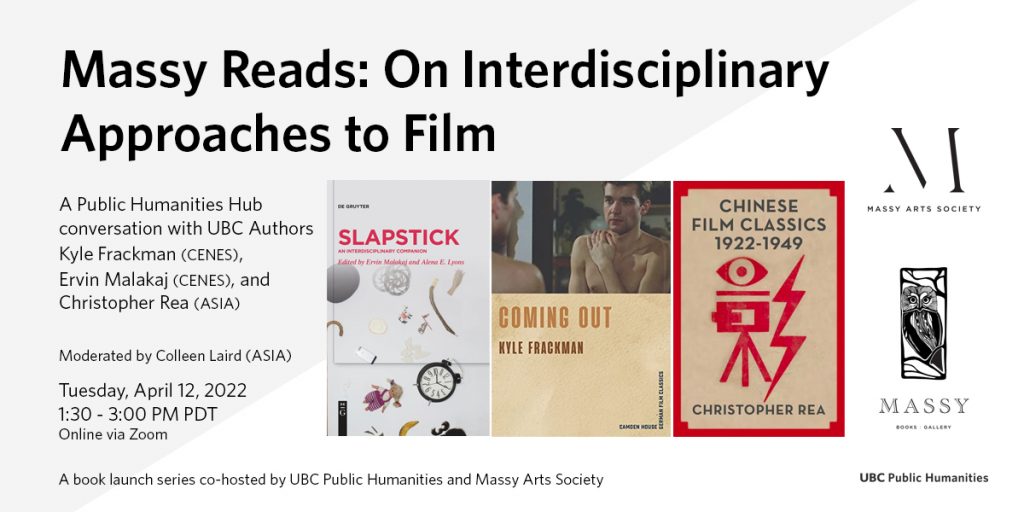
A Public Humanities Hub Conversation with Kyle Frackman, Ervin Malakaj, and Christopher Rea
A book launch series co-hosted by UBC-V Public Humanities and Massy Arts Society.
Books can be purchased through Massy Books. This event is free and open to the public.
Please join us for a book launch and conversation with UBC authors, moderated by Dr. Colleen Laird (Asian Studies).

Coming Out
(Camden House)
Dr. Kyle Frackman (Central, Eastern & Northern European Studies)
This book examines the creation, context, and significance of the first and only East German feature film about homosexuality. Acclaimed director Heiner Carow created a film that shows the difficulties, both internalized and external, that queer people faced in East Germany. In a quirk of history, Coming Out premiered in German theaters on November 9, 1989, the very night on which the Berlin Wall was opened, which meant the film was initially overshadowed, to say the least, by the earthshaking political events. Yet it remains a popular film and is regularly screened around the world, including prominently at queer film festivals. Kyle Frackman’s book examines the film in both the late East German context of its creation and the international context of its reception.
View the film Coming Out on Kanopy (free for UBC Library and VPL cardholders): https://www.kanopy.com/en/product/116674

Slapstick: An Interdisciplinary Companion
(De Gruyter)
Edited by Dr. Ervin Malakaj (Central, Eastern & Northern European Studies) and Alena E. Lyons (Eberhard Karl University)
Despite its unabated popularity with audiences, slapstick has received rather little scholarly attention, mostly by scholars concentrating on the US theater and cinema traditions. Nonetheless, as a form of physical humor slapstick has a long history across various areas of cultural production. This volume approaches slapstick both as a genre of situational physical comedy and as a mode of communicating an affective situation captured in various cultural products. Contributors to the volume examine cinematic, literary, dramatic, musical, and photographic texts and performances. From medieval chivalric romance and nineteenth-century theater to contemporary photography, the contributors study treatments of slapstick across media, periods and geographic locations. The aim of a study of such wide scope is to demonstrate how slapstick emerged from a variety of complex interactions among different traditions and by extension, to illustrate that slapstick can be highly productive for interdisciplinary research.

Chinese Film Classics, 1922–1949
(Columbia University Press)
Dr. Christopher Rea (Asian Studies)
Christopher Rea reveals the uniqueness and complexity of Republican China’s cinematic masterworks, from the comedies and melodramas of the silent era to the talkies and musicals of the 1930s and 1940s. Each chapter appraises the artistry of a single film, highlighting its outstanding formal elements, from cinematography to editing to sound design. Examples include the slapstick gags of Laborer’s Love (1922), Ruan Lingyu’s star turn in Goddess (1934), Zhou Xuan’s mesmerizing performance in Street Angels (1937), Eileen Chang’s urbane comedy of manners Long Live the Missus! (1947), the wartime epic Spring River Flows East (1947), and Fei Mu’s acclaimed work of cinematic lyricism, Spring in a Small Town (1948). Rea shares new insights and archival discoveries about famous films, while explaining their significance in relation to politics, society, and global cinema. Lavishly illustrated and featuring extensive guides to further viewings and readings, Chinese Film Classics, 1922–1949 offers an accessible tour of China’s early contributions to the cinematic arts.
Watch 25 free Chinese films with English subtitles, including the 14 films discussed in Christopher Rea’s book, at https://chinesefilmclassics.org
Please also join us for a partner event, a screening of Das alte Gesetz (The Ancient Law) and live musical accompaniment on April 1, 2022.
Please note that this event may be recorded via Zoom and posted publicly. The recording may contain attendees’ names and images. We recognize that this may be undesirable for some participants. If you do not wish for your name or image to be used in the video, please leave your video turned off during the event. You may also change your name to something generic like “Participant” or “Anonymous” in the Zoom meeting room by selecting yourself from the participants list and editing your name. By registering for this event and clicking the Zoom link that will be emailed to you, you consent to being recorded and are aware of actions you can take to anonymize yourself during the event. If you do not want to participate in the live session, the recording will be posted at a later date to our YouTube channel.
This event is being broadcast from the unceded territories of the Musqueam, Squamish and Tsleil-Waututh Nations.

